
Art, Culture, the Malecon, and Shopping in Puerto Vallarta
Beneath the beach-town surface, Puerto Vallarta is one of Mexico's most genuinely artistic places, and the best way to experience it is on foot. The oceanfront Malecon is a free outdoor sculpture museum, the Centro galleries throw open their doors every Wednesday, the back streets are painted with murals, and the markets are full of silver, pottery, and folk art worth taking home. This is a walkable tour of the city's creative side, four movements that flow naturally from the boardwalk to the galleries to the mural walls to the market stalls, with a little Hollywood history woven through.
The short answer
Puerto Vallarta's creative side has four parts. The Malecon is a free outdoor sculpture museum, best at sunset when the street performers come out. The Centro galleries host a free Art Walk every Wednesday evening from late October to May. The Zona Romantica and 5 de Diciembre back streets are dense with murals for a self-guided walk. And the markets sell silver, Talavera, Huichol art, vanilla, and raicilla, where knowing how to spot the real thing and when to haggle pays off. It all traces back to the 1963 film that made the town famous.
The Malecon: a free outdoor museum
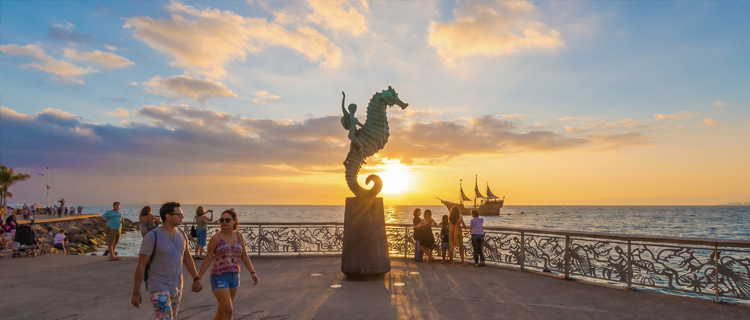
Start at the water. The Malecon, the roughly kilometer-long seaside boardwalk that runs along Centro, doubles as the city's most-visited art gallery, lined with bronze sculptures added over the decades and free to walk any time. The best-known is The Boy on the Seahorse, the charro-hatted boy astride a seahorse that has become the symbol of Puerto Vallarta. From there you pass the leaping dolphins of the Friendship Fountain, which marks the city's sister-city bond with Santa Barbara, and the whimsical Triton and Mermaid. Two works reward a closer look: Sergio Bustamante's In Search of Reason, a set of surreal figures with two of them climbing a tall ladder toward the sky, which people love to pose on, and Alejandro Colunga's Rotonda del Mar, a cluster of bronze thrones fused with sea-creature forms that you are meant to sit among. The most touching is Ramiz Barquet's Nostalgia, an older couple seated on a bench: the artist made it for his own wife, whom he lost touch with for twenty-seven years before they reunited and married. At the far north end, by Hotel Rosita, the tall bronze spiral of Millennia charts the sweep of human history.
The Malecon is best experienced around sunset, when the west-facing bay lights up and the boardwalk shifts from afternoon stroll to evening spectacle. Near the main plaza, the four white arches of Los Arcos amphitheater host free live music and folk-dance performances, and the promenade fills with street performers: mimes and living statues, sand sculptors building elaborate works on the beach below, and, most striking of all, the Voladores de Papantla, whose ancient Totonac ritual sends four men spinning slowly upside down from a tall pole, a ceremony recognized by UNESCO as intangible cultural heritage.
The galleries and the Wednesday Art Walk
Puerto Vallarta has a serious gallery scene, and the easiest way into it is the Art Walk, a free open-house evening held every Wednesday from 6 to 10 pm through the winter season, roughly late October to late May. Around fifteen galleries in the Centro art district open their doors, pour a glass of wine, and give you the chance to talk with the artists, all within a compact, walkable cluster. Long-standing rooms worth seeking out include Galeria Corsica, known for internationally collected artists, Galeria Pacifico, one of the oldest in the city, and Galeria Colectika, a top spot for high-end Huichol and contemporary indigenous work. Over in the Zona Romantica, the large Galleria Dante pairs a gallery with a sculpture garden. Even outside the Wednesday evenings, most galleries welcome browsers during the day, so the art is there whenever you are.
The street art and mural scene
Beyond the galleries, Puerto Vallarta's walls are a gallery of their own, and touring them is a free, self-guided cobblestone walk. The densest concentration is in the Zona Romantica, especially along Basilio Badillo, Olas Altas, and Lazaro Cardenas, with Lazaro Cardenas Park anchoring the south end and its reef-conservation mural project. The other major hotspot is the 5 de Diciembre neighborhood just north of Centro, which holds some of the city's largest collaborative murals, with themes running from Mexican musicians and humpback whales to Day of the Dead. Because street art is transient, with new pieces appearing and older ones fading or being painted over, the scene rewards simply wandering these two neighborhoods and looking up. It pairs naturally with the walk to the galleries or a meal out, and if you want a route on foot, our guide to the best walks and hikes in Puerto Vallarta includes the Malecon stroll.
Shopping and what to bring home
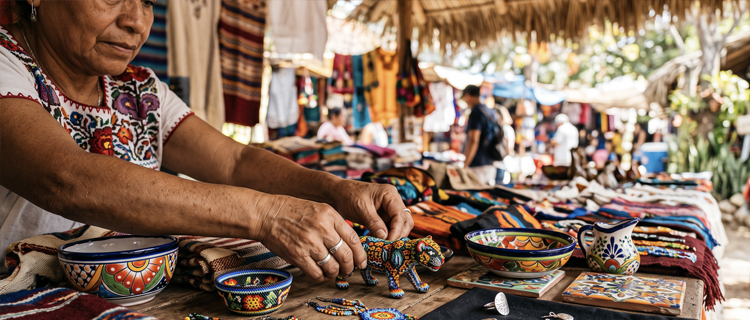
Puerto Vallarta is a genuinely good place to shop for Mexican craft, if you know what you are looking at. Silver is the classic buy, concentrated along Juarez Street in Centro; genuine sterling is stamped .925, and you are safest buying from established shops rather than beach vendors, since base-metal alloys sold as silver are common. Talavera, the hand-painted ceramic, is another prize, but authentic Talavera comes only from the Puebla region and carries a signed, certified base, so treat suspiciously cheap pieces with care. The region's most distinctive folk art is Huichol, or Wixarika, work: intricate beaded animals and bowls and yarn paintings called nierika, made by pressing beads or yarn into beeswax, each pattern carrying symbolic meaning around peyote, deer, and fire. Real Huichol work has tight, deliberate, coherent beadwork, and the specialist galleries are the place to find it.
For edible and drinkable souvenirs, buy pure Mexican vanilla but read the label and avoid any bottle listing tonka bean, which can contain a compound best not consumed. And do not leave without raicilla, the agave spirit of the Puerto Vallarta region, a cousin of tequila and mezcal with its own denomination of origin that is hard to find outside western Mexico. Two markets are worth your time: the Mercado Municipal Rio Cuale downtown, a two-floor warren of crafts, silver, and leather with food stalls upstairs, where haggling is expected, and the Marina Vallarta art and market night, held Thursdays from 6 to 10 pm through the winter season along the marina boardwalk. On haggling in general, negotiate at markets and with street and beach vendors, opening around half the asking price and landing somewhere near twenty to thirty percent off while keeping it friendly, but treat prices as fixed in established stores and galleries. When you are done shopping, the Centro and Zona Romantica galleries sit steps from many of the tables in our Puerto Vallarta dining map.
A little Puerto Vallarta art history
Puerto Vallarta's creative identity is not an accident, and the origin story adds real warmth to a visit. In 1963, the director John Huston came to the then-remote cove of Mismaloya, just south of town, to film The Night of the Iguana, adapted from the Tennessee Williams play and starring Richard Burton alongside Ava Gardner and Deborah Kerr. Burton brought Elizabeth Taylor with him, and because their romance was a very public scandal at the time, more than a hundred foreign journalists descended on what was then a fishing village of some fifteen thousand people. The resulting flood of publicity turned Puerto Vallarta into an international destination almost overnight. Burton bought Taylor the hillside villa Casa Kimberly in the cobblestoned expat neighborhood known as Gringo Gulch, then bought the house across the street and joined the two with a pink arched pedestrian bridge, the Bridge of Love, which still spans the street today and remains one of the town's most romantic landmarks. A statue of Huston stands on the Isla Rio Cuale, and the city's film festival still nods to that era, a reminder that the art on the Malecon grew from a town that has been telling stories for a long time.
Frequently asked questions
What is the Puerto Vallarta Art Walk and when is it?
The Art Walk is a free, long-running gallery open-house held every Wednesday evening from 6 to 10 pm through the winter season, roughly late October to late May. Around fifteen galleries in the Centro art district open their doors, pour complimentary wine, and let you meet the artists, all within easy walking distance of each other. It is one of the best low-key evenings in the city and a good way to see serious Mexican art without a museum ticket.
What are the famous sculptures on the Malecon?
The Malecon is an open-air sculpture gallery. The best known is The Boy on the Seahorse, the charro-hatted boy riding a seahorse that serves as the city's symbol. Others to look for include Nostalgia, a bronze of an older couple on a bench with a real love story behind it, the ladder-climbing figures of Sergio Bustamante's In Search of Reason, the surreal sea-creature thrones of Alejandro Colunga's Rotonda del Mar, the often-photographed Triton and Mermaid, and the tall spiral of Millennia at the north end by Hotel Rosita.
Where can I see street art and murals in Puerto Vallarta?
The mural scene is best explored as a free, self-guided cobblestone walk. The highest concentration is in the Zona Romantica, along Basilio Badillo, Olas Altas, and Lazaro Cardenas, with Lazaro Cardenas Park anchoring the south end. The other hotspot is the 5 de Diciembre neighborhood just north of Centro, home to some of the city's largest collaborative murals. Because street art changes as new pieces appear and old ones fade, half the fun is simply wandering and looking up.
What should I buy in Puerto Vallarta, and how do I know it is authentic?
The standout souvenirs are silver, Talavera pottery, Huichol beaded art, pure Mexican vanilla, and local spirits. For genuine sterling silver, look for a .925 stamp and buy from established shops rather than beach vendors. Authentic Talavera comes only from the Puebla region and carries a signed, certified base. Real Huichol work has tight, deliberate beadwork with coherent symbolic patterns. For vanilla, buy pure extract and avoid any bottle listing tonka bean. And raicilla, the local agave spirit, is the most distinctive bottle to take home.
Is it OK to haggle when shopping in Puerto Vallarta?
Yes, in the right places. Haggling is expected at markets, street stalls, and with beach vendors for crafts, jewelry, and souvenirs, and it is part of the fun. A common approach is to open around half the asking price and settle somewhere in the range of twenty to thirty percent off, staying friendly throughout. At established stores and galleries, prices are fixed, so do not try to negotiate there. Paying in pesos and in cash generally gets you a better price than dollars.
What is the Richard Burton and Elizabeth Taylor connection to Puerto Vallarta?
It is the story that put Puerto Vallarta on the map. In 1963, John Huston filmed The Night of the Iguana at nearby Mismaloya, and Richard Burton, who starred in it, brought Elizabeth Taylor along while their romance was an international scandal. The world's press followed them to what was then a small fishing village, and the publicity transformed it into a destination. Burton bought Taylor the villa Casa Kimberly in the hillside Gringo Gulch neighborhood and connected it to a second house with a pink arched Bridge of Love that still spans the street today.
Stay in the middle of the art
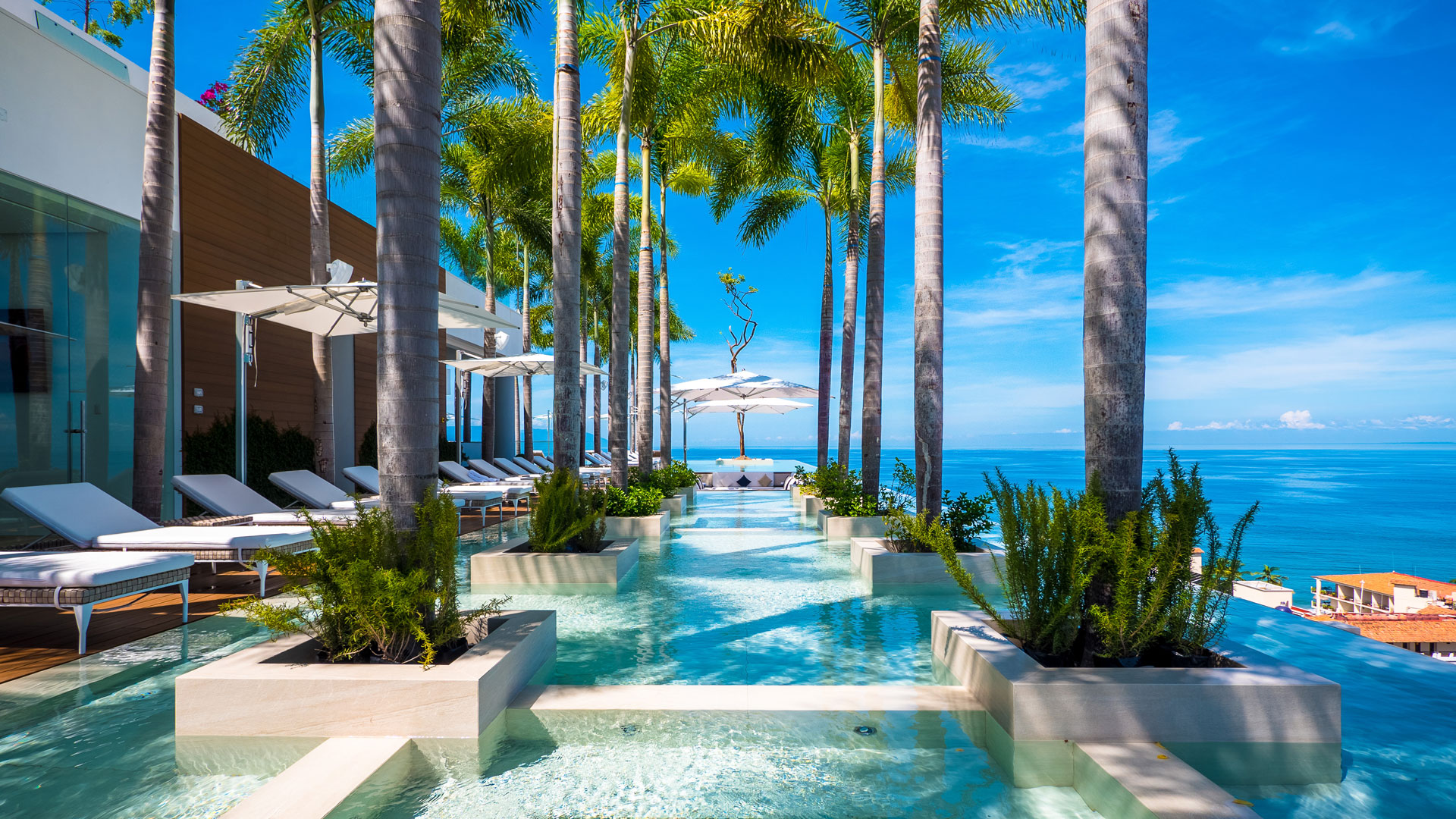
To do this the way it is meant to be done, on foot, stay in Centro or the Zona Romantica, within walking distance of the Malecon, the galleries, and the mural streets. A Naya Homes rental puts you right in the walkable heart of it. Browse vacation rentals in Puerto Vallarta, or explore the wider Puerto Vallarta area to plan your trip.
Find your Puerto Vallarta rental