Working Remotely from Puerto Vallarta: The Digital Nomad and Monthly-Stay Guide
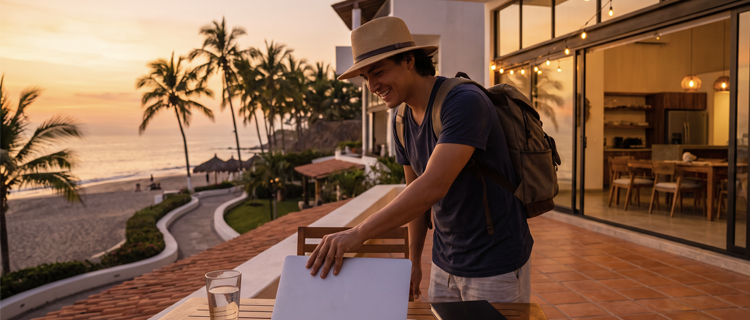
Imagine closing your laptop at 3 p.m., walking four blocks, and being in the Pacific by 3:15. That is not a fantasy in Puerto Vallarta; it is a Tuesday. The city has quietly become one of Mexico's most livable bases for remote work, pairing a beautiful, walkable bay with the practical things a remote worker actually needs: fiber internet, a few real coworking spaces, a time zone that lines up neatly with North American teams, and an established community of nomads and expats who have already figured out the logistics and are happy to share them over a coffee. This guide is for anyone weighing a month or a whole season here. It covers the honest practical foundation, the neighborhoods that suit remote workers, the daily rhythm that makes people extend their stays, the real trade-offs, and why a furnished monthly rental beats a hotel or a roll of the dice on a nightly listing every time.
The short answer
Puerto Vallarta works well for digital nomads and slow travelers. Fiber internet of 100 to 500 Mbps is common in modern buildings, though not flawless, so keep a mobile-hotspot backup. The Central time zone, fixed year-round since Mexico dropped daylight saving in 2022, overlaps a full US and Canada workday. A comfortable month runs roughly 3,500+ US dollars on a monthly rental. The Zona Romantica suits social, walkable living, Versalles the food scene, and the Marina and Nuevo Vallarta quiet and space. Book a furnished monthly rental with a real workspace and verified wifi rather than gambling on a short-term listing.
Internet, connectivity, and your backup plan
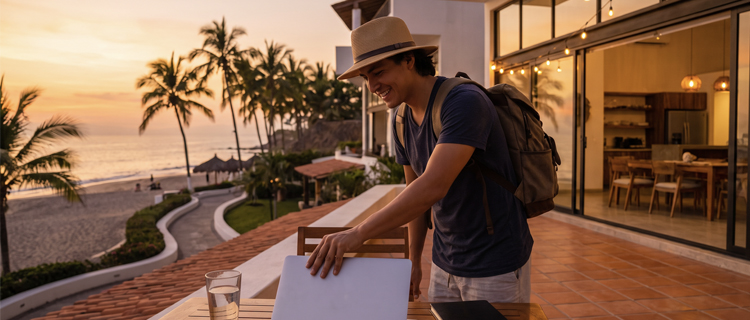
Internet is the make-or-break factor for remote work, and the honest picture in Puerto Vallarta is good but not perfect. Fiber is widely available from providers like Telmex Infinitum, Totalplay, and izzi, and plans of 100 to 500 Mbps are standard in newer buildings, with gigabit in fiber-wired zones, which is plenty for video calls and streaming. What you should not expect is flawless uptime. Outages of a few hours do happen, more often during the rainy and hurricane season or when a power cut takes the connection down, and older buildings on cable or DSL are the weakest. Totalplay is frequently rated the most reliable pure-fiber option, but the single most useful thing you can do is have your host run a live speed test on the actual unit before you commit to a monthly stay.
Because no home connection is guaranteed, a backup is not optional if your work depends on calls. The simplest is a mobile hotspot: a local Telcel or AT&T Mexico SIM on a different network than your home line means that when the wifi drops, you tether and keep going. For staying connected generally, Telcel has the best coverage and even includes free roaming in the US and Canada, AT&T Mexico is a solid urban alternative, and if you want to be online the moment you land, an eSIM from a provider like Airalo gets you data without hunting for a shop. A local prepaid SIM is cheaper for a long stay, and many nomads simply run their home fiber plus a hotspot as a two-connection setup.
The time-zone advantage for US and Canada teams
One of Puerto Vallarta's underrated perks is its clock. The city sits in Mexico's Central time zone, UTC minus 6, and it stays there all year, because Mexico abolished daylight saving time across most of the country in 2022. Since the United States still springs forward and falls back while Puerto Vallarta does not, the exact offset shifts with the US seasons, but the result is friendly in every case. In the US winter it matches Central time exactly, sitting one hour ahead of the Mountain zone, two ahead of the Pacific, and one behind the Eastern. In the US summer it is an hour behind Central, level with Mountain, an hour ahead of Pacific, and two behind Eastern. In practical terms you overlap a full North American business day no matter where your team sits, with a worst case of only about two hours' gap. For anyone working with US or Canadian colleagues, that easy overlap is a real, daily advantage: you keep your meetings, your team barely notices you have moved, and the only thing that changes is the view behind you on the video call.
Coworking spaces and laptop-friendly cafes
If you would rather not work from your rental every day, Puerto Vallarta has a small but solid coworking scene. Vallarta Cowork sits right in the Zona Romantica near the Malecon, with fiber wifi, air conditioning, phone booths, and a terrace, and it is the most central option for the Old Town crowd. Angulo Cowork, on the edge of the Zona Romantica, advertises gigabit fiber and soundproof private offices for call-heavy days, and Natureza Cowork over in the Versalles area pairs desks with a cafe. Day passes typically start around nine dollars and monthly hot-desk memberships commonly run about 100 to 200 dollars, though it is worth confirming current rates and hours directly, since the coworking scene turns over.
For lighter work or a change of scene, the city has a deep bench of laptop-friendly cafes, concentrated in the Versalles and 5 de Diciembre neighborhoods and the Zona Romantica, where a good flat white, a shaded patio, and reliable wifi are easy to find, and where you will start recognizing the same faces after a week. A rotation of a home desk for deep work, a coworking membership for call-heavy days, and a favorite cafe or two for a change of pace tends to be the sweet spot, and it is one of the small pleasures of working from here: your office can be wherever the light is best that morning.
What a month actually costs
Puerto Vallarta is not the cheapest spot in Mexico, but it remains very affordable by US and Canadian standards, and the numbers work well for a monthly stay. A comfortable, non-luxury month for one person starts at $3,500 US dollars, and the biggest variable by far is housing, which is why booking a furnished monthly rental rather than nightly stays makes such a difference. Here is a realistic breakdown of typical ranges.
| Monthly expense (one person) | Typical range (USD) |
|---|---|
| Furnished monthly rental (studio or 1BR) | $3,500+ |
| Food (mix of cooking and eating out) | $300 – $800 |
| Coworking (optional) | $100 – $200 |
| Local SIM and mobile data | $15 – $40 |
| Local transport (buses and Uber) | $50 – $150 |
| Comfortable monthly total | ~$3,900+ |
Two caveats keep these honest. Prices climb in the November-to-April high season and soften in the quiet summer, so the same apartment can vary by a lot depending on when you book, and these figures exclude flights and health insurance. For a sense of the rental market, our roundup of apartments for rent in Puerto Vallarta is a useful starting point.
The best neighborhoods for remote workers
Where you base yourself shapes the whole experience, and three areas suit remote workers particularly well. The Zona Romantica, or Old Town, is the walkable, social heart: cobblestone streets, cafes, restaurants, coworking, a beach, and the city's biggest concentration of expats and nomads all within a few blocks, with a vibrant nightlife scene right on your doorstep for the evenings you want one. It is the easy default for a first stay and for anyone who wants instant community without a car. Versalles, a once-sleepy residential grid that has become the city's buzziest food district, offers a more local, lower-key base with the best casual dining in town and a growing cafe-and-coworking scene; it is popular with nomads who want to eat extraordinarily well and live among neighbors rather than tourists. And for quiet and space, the Marina and, across the bay, Nuevo Vallarta trade walkable buzz for calmer, more resort-style living, flat and easy, with newer buildings, bigger terraces, and a slower pace that some remote workers find is exactly what a focused month needs. There is no wrong answer here, only the one that matches how you like to spend a Wednesday evening.
The rhythm of the remote-work life
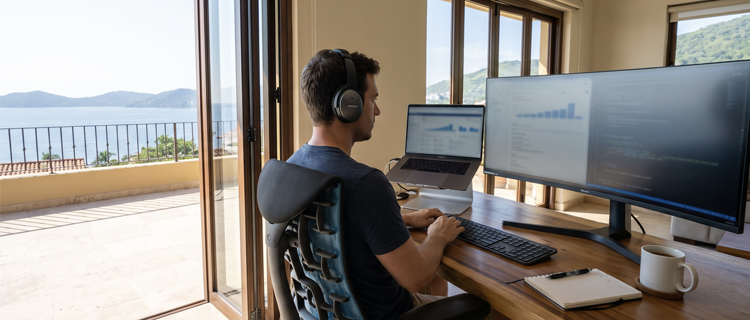
The reason people extend a week into a month here, and a month into a season, is the rhythm the place makes possible. Because you overlap the North American workday, most remote workers front-load the day: coffee on the terrace as the bay wakes up, a focused morning of calls and deep work, lunch from the kitchen or the taco stand on the corner, then trading the desk for the water by mid-afternoon. A swim, a paddle, a sunset walk on the Malecon, a slow crawl through the Versalles food scene. The bay is right there, so the reward for a productive morning is never more than a few minutes away, and it changes how you work: mornings get sharper when there is a beach waiting at the end of them. Just as importantly, you are not doing any of this alone. Puerto Vallarta has a real, easy-to-join community of remote workers and expats, with active digital-nomad and expat groups on social media, regular meetups and mixers, coworking events, beach volleyball, yoga, and weekly markets, so a solo month never has to feel solitary. It is the kind of place where the working life and the good life are so easy to combine that you stop thinking of them as separate, and where the dinner scene, from our neighborhood dining map to a night out on our nightlife guide, keeps the after-work hours as interesting as the work itself.
The honest trade-offs
No place is perfect, and a good long stay comes from planning around the downsides rather than being surprised by them. The first is the weather cycle: the rainy season, roughly June through October, is hot and humid with near-daily afternoon storms, which also raises the odds of an internet or power blip, though it brings cheaper rentals and thinner crowds; the dry high season from November to April has the best weather but the biggest crowds and the highest prices, peaking with the winter snowbirds. The second is getting around, which is easy but not effortless: you do not need a car, since Uber and buses are cheap and the Zona Romantica is walkable, but rideshare pickups are restricted at the airport due to long-running taxi friction, so plan for that on arrival. The third, and the one most worth researching before a long stay, is your permit. The tourist permit that once granted an automatic 180 days is no longer guaranteed, because immigration officers now decide and write in the number of days, often fewer, so if you are planning several months you should state your plans clearly and, for a full season or repeat visits, look into temporary residency through a Mexican consulate. Rules change, so confirm the current situation with official sources before you book a long stay. The waterfront afternoons, meanwhile, are covered in our guide to Banderas Bay beaches.
Why a monthly rental beats a hotel or a short-term gamble
All of this points to one decision that matters more than any other for a remote-work stay: where you live. A hotel room is built for a few nights, not a month of work, with no proper desk, no kitchen, and a nightly rate that adds up alarmingly fast. A nightly Airbnb solves some of that but introduces a real risk, since you often cannot verify the internet until you arrive, and a listing whose wifi cannot hold a video call is a serious problem when your paycheck depends on it. A furnished monthly rental is the answer, and it is the upgrade that turns a trip into a life: a dedicated workspace with a real desk and a chair you can sit in for eight hours, a kitchen for meals on your own schedule, in-unit laundry, separate living space so the bedroom stays a bedroom, and, crucially, connectivity you can confirm before you commit, all typically for far less per night than a hotel or a string of nightly bookings. It is exactly what Naya Homes monthly and extended stays are built for, with furnished homes and condos across the bay, verified wifi, and a local team a message away if anything needs sorting while you are here. You get to spend your energy on the work and the water, not on chasing a router.
Frequently asked questions
Is Puerto Vallarta good for digital nomads?
Yes, and it has quietly become one of Mexico's better bases for remote work. You get fiber internet in most modern buildings, a handful of real coworking spaces, a time zone that lines up with North American teams, an established and easy-to-join expat and nomad community, and a walkable, affordable lifestyle on a beautiful bay. It is not without trade-offs, mainly internet that is not 100 percent reliable and a humid rainy season, but for a month or a season it is hard to beat.
How reliable is the internet, and what should my backup be?
Fiber plans of 100 to 500 Mbps are common in newer buildings and are plenty for video calls and streaming, but honesty matters here: the internet is not flawless, and outages of a few hours do happen, more often in the rainy and hurricane season or during a power cut. The fix is a backup. Keep a Telcel or AT&T mobile hotspot on a different network for call-critical days, or use a coworking membership as a fallback location, and always have your host run a live speed test before you commit to a monthly rental.
What time zone is Puerto Vallarta, and does it work for US and Canada teams?
Puerto Vallarta is on Central Time, UTC minus 6, and it stays there all year, because Mexico abolished daylight saving time in most of the country in 2022. Since the US still changes its clocks and Puerto Vallarta does not, the offset shifts with the seasons but the overlap is excellent either way: it matches US Central time in winter and is only an hour off in summer, and even the worst case, the US East Coast in summer, is just two hours. You overlap a full North American workday year-round.
What does a month in Puerto Vallarta cost?
A comfortable, month for one person runs roughly 3,500+ US dollars on a monthly rental, though it varies with your rental and the season. The single biggest lever is housing: booking a monthly furnished rental costs far less than stringing together nightly stays, and the high season from November to April is pricier and tighter than the quiet summer. Food, coworking, a local SIM, and transport are all reasonable on top of that. See the budget table above for typical ranges.
Do I need a car to live in Puerto Vallarta?
No. In the city you can get by easily without one: Uber operates widely and is cheap, the local buses cost about 50 cents, and the Zona Romantica, Centro, and Malecon are all walkable. A car only really helps if you want to regularly explore the wider bay, like Sayulita or the jungle towns. One quirk to know: because of long-running friction between taxis and rideshare at the airport, Uber pickups there are restricted, so you often walk to the pedestrian bridge to get collected.
How long can I stay on a tourist permit?
This has changed, so plan carefully. The tourist permit used to grant an automatic 180 days, but that is no longer guaranteed: immigration officers now decide the number of days and write it in, often fewer than 180, and it cannot be extended once you are in the country. For a stay of a few weeks this rarely matters, but if you are planning several months, state your plans clearly at immigration and ask for enough days rather than assuming. For a full season or repeat stays, temporary residency, applied for at a Mexican consulate abroad, is the intended route. Always check current rules with official sources.
Is a monthly rental better than a hotel or a short-term listing?
For remote work, clearly yes. A furnished monthly rental gives you the things a hotel room cannot: a dedicated desk and chair to actually work from, a kitchen for real meals on your own schedule, laundry, and separate living space, usually for far less per night than a hotel or a nightly Airbnb. The other advantage is certainty. Booking a managed monthly stay with verified wifi and local support avoids the common short-term-listing gamble of arriving to find the internet cannot hold a video call. Naya Homes offers monthly and extended stays built for exactly this.
A month in Puerto Vallarta rarely stays a month. People arrive with a suitcase and a project deadline and leave with a favorite cafe, a Sunday routine, and a plan to come back for the whole winter. The logistics are easier than they look, the community is warmer than you expect, and the bay has a way of making your work feel lighter. All it really takes to get started is the right home to work from.
Your desk with a view is waiting
A great month on the bay starts with the right home base: a furnished rental with a dedicated workspace, verified wifi, a full kitchen, and a local team that has your back. Naya Homes offers monthly and extended stays across Puerto Vallarta, Nuevo Vallarta, and the Riviera Nayarit, built for exactly the kind of stay this guide describes. Browse Naya Homes monthly and extended stays, explore the wider Puerto Vallarta area, or get in touch and tell us how long you are thinking. We will help you find the place, confirm the wifi, and get you settled so your first Monday here feels like your best one yet.
Book your monthly stay with Naya Homes